
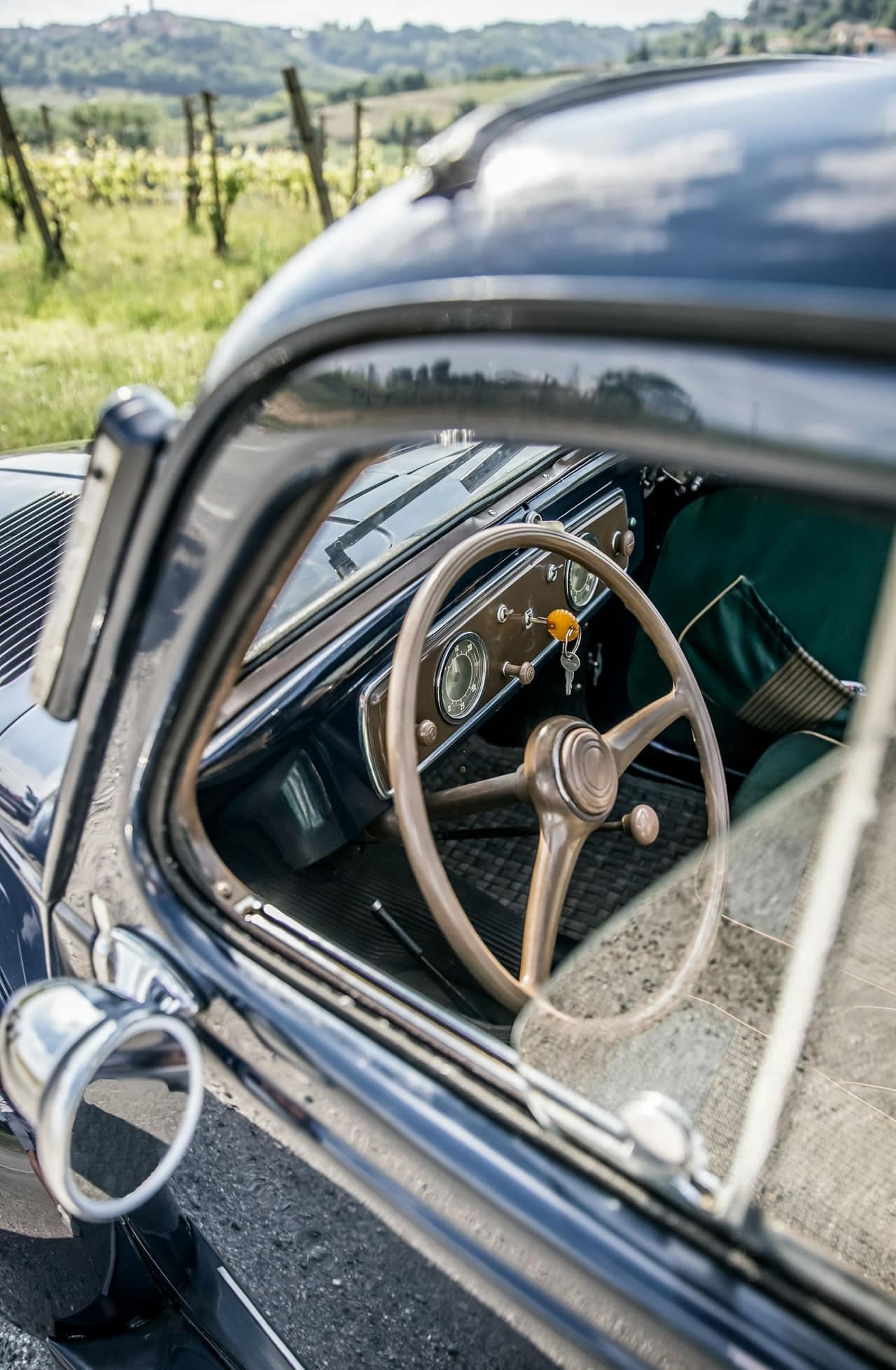
The steering wheel: a part of your car you literally hold every day
Think for a moment about how much time you spend holding the steering wheel of your car. If you drive an average of an hour a day, that is hundreds of hours per year. Your hands are on that wheel more than on almost anything else in your life, including your keyboard or your phone. And in spite of that, the steering wheel is one of the most neglected parts of the interior when it comes to maintenance and replacement.
And steering wheels wear. The leather rubs through, the rubber becomes tacky or crumbles, the stitching unravels. On older cars the wheel can look like it has been through a war. And then you reach the question: buy a new wheel for EUR 300 to 800, or find a quality used one for EUR 50 to 200? In most cases the answer is fairly clear.
Steering wheels with airbags: safety first
Most modern cars have an airbag built into the centre of the steering wheel. That is the round cover with the manufacturer's logo that opens in the event of a crash and inflates a cushion to protect you from impact against the wheel. When buying a used steering wheel, the airbag question is absolutely critical and must not be ignored.
First and most important: never buy a wheel whose airbag has already been deployed. A deployed airbag is useless because it cannot be re-inflated. On top of that, the deployment mechanism itself is single-use, so even if you somehow put in a new cushion the mechanism may not work properly. That is a risk no one should take.
When inspecting a used steering wheel with an airbag, check the airbag cover. It must not have cracks, deformations or signs of gluing. If the cover is glued or repaired in any way, that is a sure sign the airbag has been deployed and someone tried to hide it. Do not buy such a wheel under any circumstances.
Why steering wheels with airbags are more expensive
Used steering wheels with an undeployed airbag are noticeably more expensive than those without. The airbag module alone can be worth EUR 100 to 300 depending on the model. But that price is still far lower than a new original wheel with airbag which can cost up to EUR 1,000.
The price is higher because the airbag is a safety system that has to be in flawless condition. Suppliers selling used wheels with airbags usually test the module before sale, which adds to the price but also to the safety of the purchase. On a platform like PoDi you can be confident that every part has been checked before it reaches you.
Legal aspects of airbags
Driving without a functioning airbag is not illegal in itself in most EU countries, but it can affect a vehicle inspection (MOT) if the car originally came with an airbag. Also, in the event of an accident, an insurance company can refuse to pay out if it turns out the safety system was not functional. That is why it is critical that a used wheel with an airbag is fitted correctly and that the airbag system works without faults.
Steering wheels without airbags: simpler but limited choice
Wheels without airbags are typical of older cars, usually built before the mid-1990s. Also, some drivers deliberately remove the airbag and fit sport wheels without one, especially on cars destined for racing or track days.
The advantage of a wheel without an airbag is simplicity. No electronics, no explosive charges, no complex connectors. Replacement is literally: take off the old one, fit the new one, tighten the nut. The price is also lower because there is no expensive airbag module.
But there are serious downsides. Without an airbag, the only thing between you and the wheel in a frontal crash is the seatbelt. Statistics show that the driver airbag reduces fatalities in frontal crashes by 30 to 40 percent. That is a huge difference to weigh up.
Multifunction steering wheels: an upgrade that makes sense
One of the most popular interior upgrades is swapping a plain wheel for a multifunction one. A multifunction wheel has buttons for radio control, cruise control, hands-free calling, and sometimes paddle shifters for gear changes. This upgrade can dramatically improve the driving experience and, with used parts, it does not have to be expensive.
The most common scenario is a VW Golf 5 or 6 owner wanting to swap their plain wheel for a multifunction one from the same generation. The mounting points are identical because it is the same car, and all you need extra is a CAN bus adapter or coding with a diagnostic tool so the car recognises the buttons on the wheel.
A similar story applies to BMW, Audi, Mercedes and other manufacturers. Within the same generation, upgrading to a multifunction wheel is relatively simple and cheap with used parts. A multifunction wheel from a scrapyard can cost EUR 80 to 150, while a new one would cost EUR 400 to 700.
Steering wheel compatibility with your car
Before buying a used wheel, check several things. First, physical compatibility. Wheels are mounted to the steering column with a splined connection. The number of splines and the diameter must match. Most manufacturers use the same spline across a generation of models, but between generations there can be differences.
Second, electrical compatibility. If the wheel has buttons, you have to check that the connectors match and that your car is fitted out for those functions. There is no point buying a wheel with cruise control buttons if your car does not have a cruise control module.
Third, airbag compatibility. The airbag connectors must match, and the clock spring in the steering column must be compatible with the new wheel. The clock spring is a coiled ribbon that maintains an electrical connection between the rotating wheel and the fixed column, and if it is not compatible neither the airbag nor the buttons on the wheel will work.
Condition of leather and wheel material
When inspecting a used wheel, focus most on the condition of the material around the rim, the part you actually hold. Leather wheels wear in characteristic places: at the ten and two positions (or nine and three for sportier driving) where your hands sit most often.
Slightly worn leather is normal and can be restored with professional leather dyeing. But if the leather is torn, cracked down to the backing, or peeling in chunks, it is better to skip that wheel. Restoring heavily damaged leather on a wheel costs almost as much as a new one.
Plastic and rubber wheels wear differently. Rubber becomes tacky over time, especially if exposed to sun. Plastic rubs through and becomes glossy at contact points. Both issues are cosmetic and do not affect function, but they do affect grip comfort.
Fitting a used steering wheel step by step
If you decide to fit a used wheel yourself, here are the basic steps. Note: this is just an informative overview. If you are not confident in your skills, leave the job to a professional, especially if the wheel has an airbag.
- Disconnect the battery and wait at least 15 minutes for the airbag system to discharge fully
- Remove the airbag module from the existing wheel (usually two or four Torx screws on the back of the wheel)
- Disconnect the connectors for the airbag and wheel buttons
- Mark the wheel position on the shaft (with a marker or chalk) so the new wheel goes in the same orientation
- Undo the central nut of the wheel and remove the old one
- Fit the new wheel on the shaft, aligning the marks
- Tighten the central nut to the specified torque
- Reconnect the connectors and fit the airbag module
- Reconnect the battery and check everything works correctly
The whole procedure takes about an hour for an experienced mechanic, or two to three hours if you are doing it for the first time. The key tools you need are a Torx set, a socket for the central nut (usually 22mm or 24mm), and ideally a torque wrench.

Used steering wheel prices: what to expect
Used wheel prices vary significantly based on car model and the wheel's equipment. Here are rough prices for the most popular categories:
- Plain wheels without airbag (older cars): EUR 20 to 60
- Plain wheels with airbag: EUR 80 to 200
- Multifunction wheels with airbag: EUR 120 to 300
- Sport wheels (M, S-line, AMG): EUR 150 to 500
- Wheels with paddle shifters: EUR 150 to 400
For comparison, a new original wheel for an average mid-range car costs EUR 400 to 1,000, and for premium brands up to EUR 1,500. The saving with a used wheel is obvious.
Where to find the right used wheel
Hunting for the right used wheel can be frustrating if you do not know where to look. Scrapyards are a decent source, but you have to visit several to find the right model in good condition. Online listings offer more choice but carry the risk of buying sight unseen.
The easiest way is to send a request to the PoDi platform. You simply enter your car's make and model, describe the wheel you want (with airbag, multifunction, sport), and PoDi connects you with suppliers who send quotes with prices and photos. No driving round scrapyards, no haggling, just pick the best offer.
Steering wheel in hand, conscience clear
A used wheel is an excellent investment, whether you are replacing a worn wheel or upgrading to a multifunction one. The key is to pay attention to the airbag condition, compatibility with your car and the material around the rim. With a little research and careful selection, you can get a wheel that looks and works like new for a fraction of the cost.
Do not forget: safety always comes first. If you are not sure about the airbag's integrity or wheel compatibility, consult a professional before fitting. Better to spend a little more on professional fitting than to risk your own safety.