


Knowing how to spot a good part is half the battle
Buying a used car part is a smart decision. But only if you buy a part that is actually any good. And that is where knowledge comes in. The difference between a good and a bad used part is sometimes obvious, and sometimes very subtle. If you do not know what to look for, you can easily get burned.
Do not worry, you do not need to be an engineer to judge the quality of a used part. You just need to know the basics and have a bit of common sense. Every type of part has its own quirks and its own warning signs that immediately give a problem away. Concrete, practical, without unnecessary theory.
Universal rules that apply to every part
There are a few things that apply to all used parts, no matter the type. Here they are.
Cleanliness tells you about care
A part that has been cleaned before sale tells you the seller cares about their business. A dirty, greasy part is not necessarily bad, but it makes inspection harder and suggests the seller did not even put in the minimum effort. Professional scrapyards clean parts before listing them. If a part is dirty beyond recognition, ask yourself why.
Signs of leaks
Any part that has anything to do with fluids (engine, gearbox, power steering pump, AC compressor) should be dry. Traces of oil, coolant or ATF fluid are a red flag. Not necessarily "do not buy", but definitely "ask why it is leaking and for how long".
Corrosion and rust
Surface corrosion on steel parts is normal, especially in coastal areas. But deep corrosion eating into the metal is a problem. Check load-bearing points, threads and seats for signs of serious corrosion.
Signs of previous repairs
If a part shows signs of welding, glue or patching, that means it has already been repaired. A repaired part is not necessarily bad, but it is worth knowing because it affects the remaining lifespan.
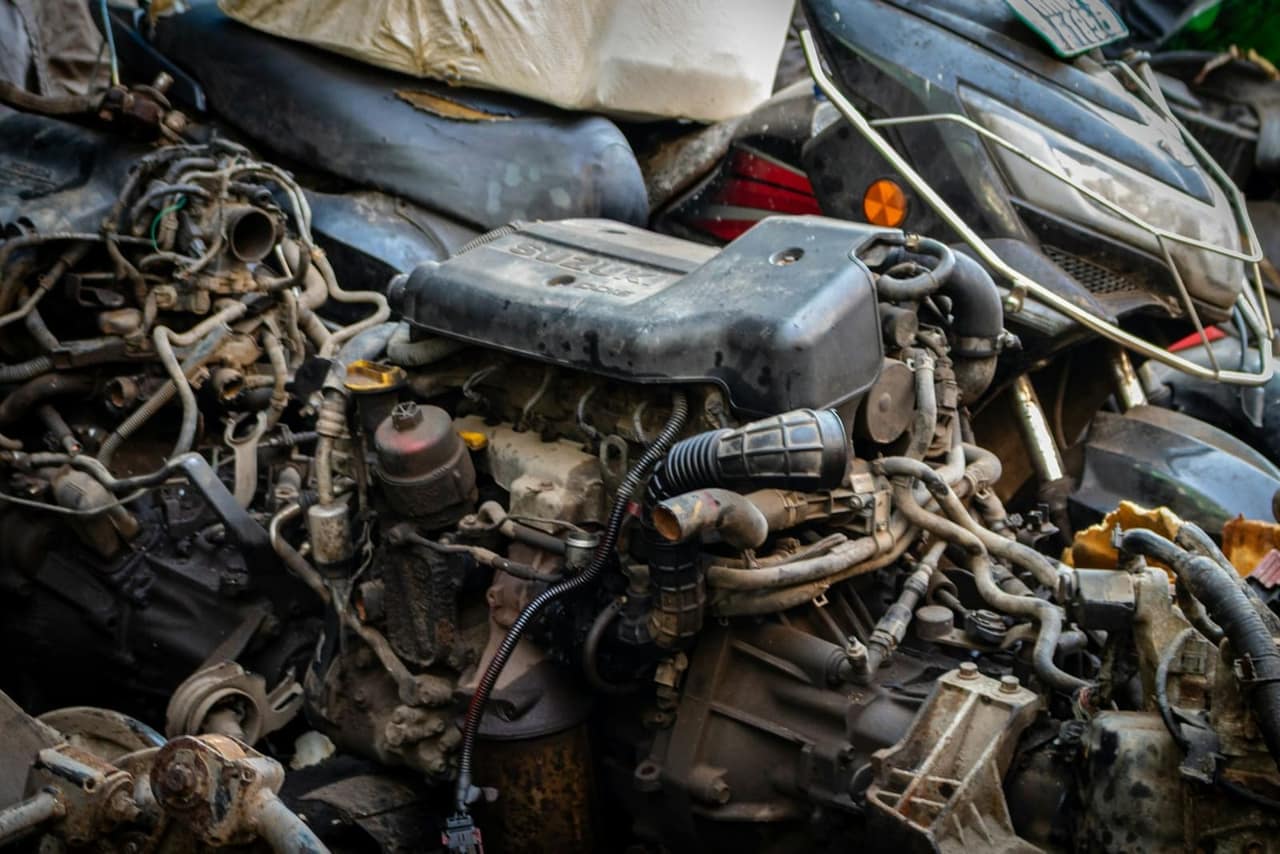
Checking an engine
The engine is the most expensive and most complex part, so it deserves the most thorough check.
Visual inspection
- Signs of oil leaks - look around the rocker cover, head gasket, sump and oil filter housing. A bit of dampness is OK, but active dripping is a problem
- State of the coolant - if there is still coolant in the engine, look at its colour. Clean green/pink is good. Brown, cloudy or with oily traces on the surface suggests a head gasket problem
- Colour of the exhaust gases (if you can run the engine) - white smoke = coolant entering the cylinder (head gasket). Blue smoke = engine is burning oil. Black smoke = mixture too rich. Clear vapour = all OK
- State of the turbo - grab the turbo shaft and try moving it up and down and side to side. Minimal play is normal, but if the shaft moves freely, the turbo is worn out
Testing
If you have the option, a compression test is the best way to check the state of the cylinders. Compression should be even between cylinders (less than 10% difference) and within the range specified by the manufacturer (typically 12 to 16 bar for petrol, 20 to 30 bar for diesel).
If you cannot do a compression test, at least look at the oil on the dipstick. Black, thick oil suggests neglected maintenance. Oil with metal particles (shiny specks) suggests internal wear.
Checking a gearbox
The gearbox is the second most expensive part, and the check is key.
Manual gearbox
- Noises - if you can rotate the input shaft, listen. Whining, squealing or knocking are bad signs
- State of the oil - drain a little oil and look at it. It should be relatively clean. Oil with metal particles means the gears are wearing
- Gear shifting - if the gearbox is still in the car, test all gears. Each should engage smoothly without grinding or resistance
- Synchros - worn synchros are recognised by gears that engage with difficulty or grind when shifting. Second and third gears wear out the fastest
Automatic gearbox
- State of the ATF fluid - it should be red or pink and translucent. Brown, dark, or smelling burnt means a problem
- Shifting - if you can test it, the shifts should be smooth, with no harsh engagement or delay
- Leaks - automatic gearboxes are especially sensitive to fluid level, so any leak is a serious problem
- Mileage - automatic gearboxes are more sensitive to mileage than manuals. DSG and CVT gearboxes with more than 200,000 km are riskier
Checking body panels
Body panels are visually the easiest to judge, but there are hidden problems.
What to look for
- Flatness - look at the panel from different angles under good light. Waviness or unevenness suggests the panel has been repaired with filler
- Colour - compare the colour with your car's colour code. Even the same colour can vary depending on the year of production and the age of the paint
- Corrosion - check edges, folded sections, and the inner side. Corrosion usually starts from the inside and spreads outward
- Plastic parts - check bumpers and plastic trim for cracks, especially around mounts and fixing points
- Magnet test - run a magnet over a metal panel. If the magnet does not stick in places, there is filler there (a repair). This is a simple but very effective test
Checking electronics
Electronic parts are special. They usually either work or they do not, but there are nuances.
ECU (engine computer)
Visually check the connector for signs of corrosion or damaged pins. Check the housing for signs of moisture or melting. Ideally, the ECU should be tested for proper function before buying. Some scrapyards have the equipment to test electronics.
Important: an ECU is often coded to a specific vehicle. Check whether it can be recoded for your car or whether you need exactly the same ECU model with the same software.
Alternator
Turn the pulley by hand. It should turn smoothly, without sticking or noise. Check the slip rings and brushes (if visible) for signs of wear. Test the charging voltage if possible (should be 13.8 to 14.4V).
Starter motor
Check the ring gear for worn teeth. If you can connect it to a battery, test that it spins strongly and evenly. A weak spin means worn brushes.
Checking headlights and lights
Headlights are a part often bought used because original headlights are expensive.
- Clarity of the lens - cloudy or yellowed glass means UV rays have damaged it. This can be polished, but it is a sign of age
- Condensation - moisture inside the headlight is a sign the seal is damaged. A bit of mist can come and go, but lasting water droplets are a problem
- Reflector - inspect the state of the reflective surface. If it is damaged or worn, the light will not light the road properly
- Brackets and ears - check that all the mounts and fixing points are intact. A broken mount means the headlight will not seat properly
- Electrical connectors - check the state of the connectors and wires. Corroded connectors can cause flickering or failure

Checking the interior
Seats, trims and other interior parts are relatively simple to judge.
Seats
- Check the fabric or leather for tears, stains and wear
- Test the movement mechanism (forward and back, backrest tilt)
- If they are heated, check that the heaters work
- Check the side airbag modules if integrated into the seat
- Check the state of the floor rails, since worn rails mean the seat wobbles
Door cards
Check that all the fixing clips are in place. Check the window regulator (mechanism and motor). Check the speaker if it is integrated. Look at the condition of the leather or fabric trim for wear.
Red flags that mean "do not buy"
There are situations where it is better to walk away and look for another part. Here is when to say no.
- The seller will not give any warranty - not even 7 days. That means they do not believe in the quality of the part themselves
- An engine or gearbox with unknown mileage - "I do not know how much it has done" is a bad answer. A serious yard knows where the part came from and how many kilometres the car had
- Price significantly below market - if everyone sells the alternator for 100 euros, and this one is selling it for 30, something is off
- The part has been "repaired" - a gearbox or engine repaired by an unknown mechanic is a risk not worth taking
- Signs of excessive corrosion - a part that has been in the sea or stood outdoors for years is probably not a good choice
- The seller dodges questions - if they will not say where the part came from, how old it is, or why they are selling it, walk away
Green flags that mean "good choice"
On the other hand, here are signs that suggest a part is good.
- The part comes with documentation - invoice, service book of the car it was removed from, test results
- The seller offers a warranty - 30 days, 60 days, or even 6 months. That shows confidence in the quality
- The part is cleaned and presented professionally - care in presentation reflects care in the business
- The seller is happy to answer questions - detailed, concrete explanations instead of evasion
- The car the part came from has a known history - regularly serviced, one owner, low mileage
When you are not sure, ask an expert
If you have no experience judging parts, do not hesitate to ask for help. Your mechanic is your best ally. Tell them which part you need, ask what to look out for, or ask them to check the part before installation.
Many mechanics are happy to take a look at a part you have bought before fitting it. It does not take them much time, and it can save you money and trouble.
A checking formula that saves you money
Checking the quality of a used part is not rocket science. You just need to know the basics for each type of part and have a bit of patience for the inspection. Visual check, check for leaks and corrosion, test where possible, and common sense. That is the formula.
And if you are buying online and cannot physically inspect the part, buy from suppliers who offer a warranty and clear return terms. On the PoDi platform you can send a request and get offers from verified suppliers who stand behind their parts. That is the safest way to buy used parts online.